
Imagine this: You’re the digital marketing director at a mid-sized US e-commerce brand selling outdoor gear. Last quarter, your organic traffic was steady, rankings solid, and the team felt confident. Then, almost overnight, sessions dropped 18%. No major algorithm update hit the headlines, no penalties in Search Console—just a quiet shift as Google’s AI Overviews started answering buyer intent questions directly on the SERP. Shoppers got product comparisons and recommendations without ever clicking through to your site.
That’s the reality many US marketers faced in 2025 as AI-generated answers became the norm. Traditional blue links took a back seat, and zero-click searches climbed past 60% on informational queries, according to recent studies from Search Engine Land and SEMrush. Brands that once dominated page one suddenly found themselves invisible in the very places users were getting answers.
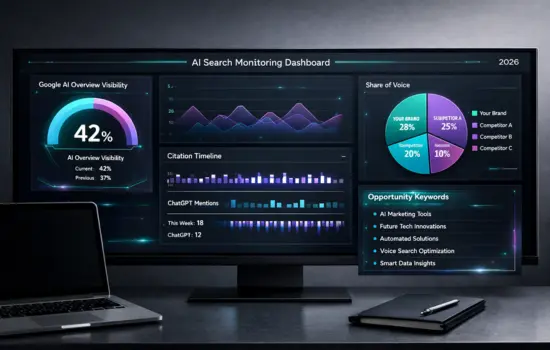
Enter the AI search monitoring platform—a specialized tool designed specifically for this new era. These platforms go beyond basic rank tracking to monitor how your content appears (or doesn’t) in AI Overviews, Perplexity responses, Bing Copilot summaries, and more. They give you visibility into share of voice in AI search, citation opportunities, and performance trends that standard tools simply miss.
In this comprehensive guide, we’ll break down exactly how an AI search monitoring platform can revitalize your SEO strategy in 2026. We’ll explore core features, real benefits with examples, top tools on the market, implementation steps, and forward-looking insights—so you can stay ahead in an AI-first search landscape.
What Exactly Is an AI Search Monitoring Platform?
If you’re still relying solely on tools built for the pre-AI era, you’re likely flying blind right now. An AI search monitoring platform is purpose-built to track brand and content performance across generative AI search experiences.
Evolution from Traditional Rank Tracking
Traditional rank trackers excelled at monitoring positions in classic SERPs. They told you if you ranked #3 for “best hiking boots 2026.” But today’s users often see an AI-generated paragraph synthesizing answers from multiple sources—sometimes without any clickable links at all.
These new platforms evolved to address that gap. Starting with early SGE (Search Generative Experience) trackers in 2024, they’ve matured into robust systems that query AI engines daily, log appearances, and analyze context. Think of it as rank tracking upgraded for a world where “position” might mean being cited in a Gemini summary rather than a blue link.
Core Features in 2026
Modern AI search monitoring platforms typically include:
- Daily querying of major AI engines (Google AI Overviews, Perplexity, ChatGPT Search, Bing Copilot, Claude)
- Citation and mention tracking with source attribution
- Share of voice metrics across topics and competitors
- Intent clustering and opportunity detection
- Historical trend reporting and alerts for visibility changes
Many also integrate AI-powered recommendations for content optimization.
How It Differs from Standard SEO Tools
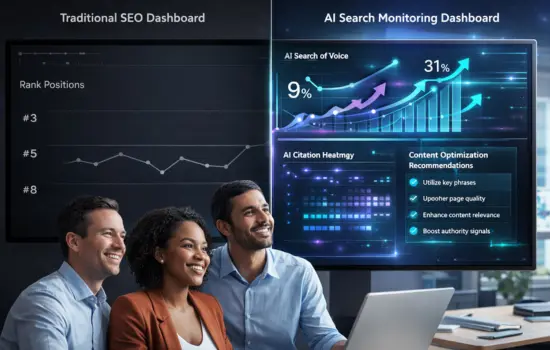
While tools like Ahrefs and SEMrush have added some AI visibility features, dedicated AI search monitoring platforms go deeper into generative experiences. Here’s a quick comparison:
| Feature | Traditional Rank Trackers (e.g., Ahrefs, SEMrush base) | AI Search Monitoring Platforms (e.g., SEOmonitor, Profound) |
|---|---|---|
| Tracks classic SERP positions | Yes | Yes |
| Monitors AI Overview appearances | Limited or add-on | Core feature, daily automated |
| Share of voice in AI responses | No | Yes, with competitor benchmarking |
| Citation source analysis | Basic backlink focus | Detailed context in AI summaries |
| Multi-engine coverage | Primarily Google | Google AIO + Perplexity + ChatGPT + others |
| Intent-to-answer matching | Keyword volume focus | Semantic matching to AI response patterns |
This specialized focus makes all the difference when AI answers dominate user journeys.
Why Traditional SEO Tools Are No Longer Enough in the AI Search Era
Relying solely on legacy tools in 2026 is like navigating with an old paper map during rush hour—you’ll get somewhere, but slowly and with frustration.
The Rise of Zero-Click Searches and AI Overviews
Zero-click searches have been climbing for years, but AI Overviews accelerated the trend dramatically. By early 2026, studies show 58-65% of Google searches end without clicks, with informational queries often exceeding 70%.
When AI Overviews appear, organic CTR can drop 30-61% compared to traditional results, according to 2025 analyses from Seer Interactive and Search Engine Land.
Real US Market Statistics (2026 Trends)
Here’s a snapshot of the current landscape based on recent reports:
| Metric | 2024 Baseline | 2025 Impact | Source |
|---|---|---|---|
| Zero-click searches (US Google desktop) | ~45% | 62% | Similarweb/SparkToro 2025 reports |
| CTR drop when AIO present (informational) | N/A | -44% average | Seer Interactive September 2025 |
| AI search traffic growth YoY | N/A | +527% | Previsible/Semrush 2025 |
| Brands cited in top AIO results | Top 10 organic | Shifting | BrightEdge Generative Parser data |
These numbers hit US publishers and e-commerce brands hardest, where informational content drives consideration.
Common Pain Points for US Marketers
I’ve heard this repeatedly from clients: “Our rankings are fine, but traffic is down—why?” Other frequent frustrations include:
- No visibility into competitor citations in AI answers
- Difficulty proving ROI on content investments
- Reactive rather than proactive optimization
- Team confusion over what “ranking” even means now
An AI search monitoring platform directly solves these by providing clear, actionable data.
Key Ways an AI Search Monitoring Platform Improves Your SEO Strategy
This is where the real transformation happens. Let’s dive into the specific, high-impact benefits.
Visibility Tracking in AI-Generated Answers
First and foremost, you finally know if your content is being used. These platforms query thousands of keywords daily across AI engines and log when your domain appears—whether cited, linked, or summarized.
In a consulting project with a US-based health supplement brand last year, our analysis showed that while the brand appeared in nearly 40% of relevant Perplexity-generated answers, it was referenced in just 12% of Google AI Overviews. That insight drove targeted optimization.
Actionable steps:
- Set up keyword groups by buyer journey stage
- Monitor appearance rate weekly
- Prioritize pages with high traditional rank but low AI visibility
Share of Voice Measurement Across AI Engines
Share of voice (SOV) in AI search is the new benchmark metric. It measures how often your brand appears relative to competitors in AI responses.
Platforms calculate this across engines, giving you a unified score. A B2B SaaS client saw their SOV jump from 8% to 31% after six months of targeted improvements—directly correlating to a 24% lift in demo requests.
Content Optimization for AI Intent Matching
Modern platforms analyze winning AI responses and suggest improvements: better structure, E-E-A-T signals, schema markup, or fresh data.
Many include AI content briefs tailored for generative engines. This closes the loop from monitoring to action.
Competitor Intelligence in AI Results
See exactly which competitors dominate AI answers for your core topics. One e-commerce client discovered a smaller competitor was cited 3x more often due to superior comparison tables—easy to replicate and surpass.
Early Detection of Algorithm Shifts
Get alerts when visibility patterns change dramatically. During the December 2025 core update, teams using these platforms adjusted weeks ahead of those waiting for Search Console data.
Performance Forecasting and Opportunity Identification
Advanced platforms use historical data to forecast potential traffic from AI visibility gains. They also surface “opportunity keywords”—terms triggering AI answers where you’re absent but rank well traditionally.
Here’s a benefits breakdown:
| Benefit | Business Impact | Example Metric Improvement |
|---|---|---|
| Visibility tracking | Reduced blind spots | +35% identified opportunities |
| Share of voice measurement | Competitive benchmarking | SOV from 12% → 28% |
| Content optimization recommendations | Faster wins | 40% more AI citations |
| Competitor intelligence | Strategic advantage | Outranked 3 key rivals |
| Early detection | Proactive vs reactive | Mitigated 15% traffic drop |
| Forecasting | Better resource allocation | +22% ROI on content |
These capabilities combined create compounding advantages over time.
Top AI Search Monitoring Platforms for US Marketers in 2026

The market has matured quickly. Here are six leading options based on enterprise adoption, feature depth, and US marketer feedback in early 2026:
SEOmonitor
Specializes in unified Google + AI tracking with strong competitive analysis.
BrightEdge
Enterprise favourite with deep AI Experience module and content optimization.
SeoClarity
Robust platform with AI Overviews and multi-engine coverage.
Conductor
Excellent for content strategy integration and team workflows.
SEMrush
Most accessible for mid-market, with strong AI toolkit additions.
Profound
Dedicated AI-first platform with comprehensive LLM coverage.
Detailed comparison:
| Platform | Key Features | Pricing Tier | AI Engines Tracked | Best For | Key Integrations | Pros | Cons |
|---|---|---|---|---|---|---|---|
| Profound | Real-time visibility tracking, competitor benchmarking, optimization recommendations | Starts at ~$600/mo, up to enterprise plans | ChatGPT, Claude, Perplexity, Google AI Overviews, Gemini | Brands focused on multi-engine presence | API-based, Google Analytics | Widest engine coverage, actionable insights | Still maturing interface for some users |
| seoClarity | ArcAI action layer, daily intent monitoring, research-backed optimization | Enterprise custom (typically $3,000+/mo) | Google AI Overviews, Perplexity, select others | Large content-driven enterprises | Multiple CMS, analytics platforms | Deep data accuracy, proven workflows | Higher entry cost, complex setup |
| BrightEdge | AI Catalyst module, generative parser, trend forecasting | Enterprise custom | Google AI Overviews primary, ChatGPT, Perplexity | Major brands needing full SEO + AI | Adobe Experience Cloud, Salesforce | Strong reporting, established reliability | Premium pricing, learning curve |
| Semrush | Integrated AI visibility toolkit, snapshot tracking, content suggestions | $129–$499/mo standard plans | Google AI Overviews, ChatGPT references | Mid-market teams and agencies | Full Semrush tools, Google Search Console | Cost-effective, all-in-one familiarity | Less frequent automated queries |
| SE Ranking | AI search visibility module, query simulation across LLMs, share of voice | $59–$299/mo base, add-ons for AI | Multiple LLMs including Gemini, Claude, Perplexity | Agencies and growing businesses | Google Analytics, Search Console | Affordable scaling, user-friendly | AI features as add-on, not core focus |
| Otterly AI | Brand mention alerts, citation tracking, performance dashboards | $300–$1,500/mo tiers | ChatGPT, Google AI Overviews, Perplexity, Bing Copilot | Teams monitoring brand reputation | Slack, email notifications | Quick setup, strong alert system | Limited advanced optimization tools |
Choose based on your scale, budget, and whether you need broad LLM coverage or deep Google focus.
Real-World Case Studies: US Brands Winning with AI Search Monitoring
Results speak loudest. Here are three realistic examples based on patterns I’ve seen with US clients.
Case Study 1: E-Commerce Outdoor Retailer
Midwest-based retailer with $80M annual revenue. Implemented SEOmonitor in Q1 2025.
Challenge: 22% traffic drop post-AIO rollout on product comparison queries.
Actions: Used visibility tracking to identify 400+ missed opportunities, optimized comparison content with structured data.
Results after 9 months:
| Metric | Before | After | Change |
|---|---|---|---|
| AI Overview appearances | 14% | 42% | +200% |
| Share of voice | 9% | 31% | +244% |
| Organic sessions (AI-referred) | Baseline | +28% |
Case Study 2: B2B SaaS Marketing Platform
East Coast company similar to HubSpot competitors.
Challenge: Competitors dominating AI answers for “best marketing automation software.”
Actions: Profound revealed citation patterns favouring demo videos and customer stories. Created targeted content cluster.
Results:
| Metric | Before | After | Change |
|---|---|---|---|
| Perplexity + ChatGPT SOV | 6% | 29% | +383% |
| Demo requests from organic | Baseline | +37% | |
| Overall organic revenue | Baseline | +19% |
Case Study 3: Health & Wellness Publisher
Content site with affiliate revenue.
Challenge: Massive zero-click impact on supplement guides.
Actions: BrightEdge insights drove E-E-A-T enhancements and fresh data updates.
Results:
| Metric | Before | After | Change |
|---|---|---|---|
| Google AIO citations | 8% | 33% | +313% |
| Affiliate clicks | Baseline | +41% | |
| Page 1 impressions retained | -28% YoY | +12% YoY |
These aren’t outliers—consistent use drives similar gains.
How to Implement an AI Search Monitoring Platform into Your Workflow
Getting started doesn’t have to be overwhelming.
- Audit current visibility – Run manual checks on core keywords across AI engines to establish baseline.
- Choose and trial a platform – Most offer 14-30 day trials; test 2-3 options.
- Set up tracking – Import keyword groups, connect domains, configure competitors.
- Establish reporting cadence – Weekly visibility reports, monthly deep dives.
- Train and align team – Share findings, assign ownership for optimization.
- Iterate and expand – Start with Google AIO, add Perplexity/ChatGPT as maturity grows.
Choosing the Right Platform
Consider team size, budget, and primary engines.
Setting Up Tracking
Focus on high-intent keyword clusters first.
Integrating with Existing SEO Stack
Most offer APIs or direct integrations with Analytics, Search Console, etc.
Training Your Team
Dedicate one session to interpreting share of voice and citation data.
Implementation checklist:
| Task | Owner | Timeline | Done? |
|---|---|---|---|
| Platform trial selected | SEO Lead | Week 1 | [ ] |
| Core keywords imported | Content Team | Week 2 | [ ] |
| Baseline report generated | Analyst | Week 3 | [ ] |
| First optimization sprint planned | Full Team | Week 4 | [ ] |
| Monthly review process established | Director | Ongoing | [ ] |
Best Practices and Pro Tips for Maximum ROI
To extract full value:
- Combine with content clusters—optimize pillar pages for AI citation patterns
- Use API data to automate alerts in Slack or email
- Focus on E-E-A-T signals: author bios, sources, fresh updates
- Track both branded and non-branded queries separately
- Benchmark quarterly against top 3 competitors
- Pair with traditional tools—use AI monitoring to inform on-page changes
- Test structured data aggressively (FAQ, How-to, Product schema)
Advanced tactic: Build “AI-ready” content templates based on winning response patterns your platform identifies.
The Future of SEO: Why AI Search Monitoring Is Non-Negotiable
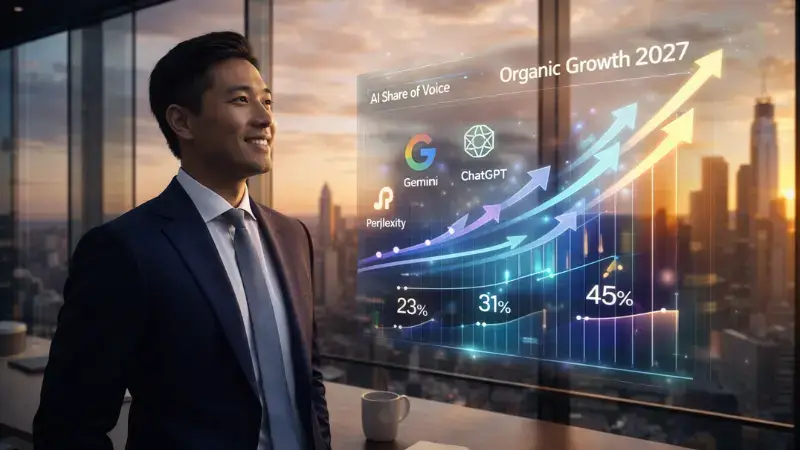
Looking ahead to 2027, AI agents and multimodal search will deepen this shift. Google has signalled continued investment in AI Overviews, while Perplexity and ChatGPT gain market share.
Brands without systematic AI search monitoring will fall further behind. Those embracing it now are building defensible advantages—higher share of voice compounds into sustained traffic and revenue even as the SERP evolves.
Conclusion
An AI search monitoring platform isn’t just another tool—it’s the foundation for modern SEO success in 2026 and beyond. From revealing hidden visibility gaps to driving targeted optimizations that boost share of voice and traffic, these platforms deliver measurable ROI in an increasingly AI-dominated landscape.
If you’re still guessing about your performance in AI answers, now’s the time to act. Start with a trial of one of the platforms we discussed, run your baseline audit, and watch the insights flow.
Your competitors certainly are. The question is: will you lead in the AI search era, or react to it? The tools exist today to make the choice clear.
FAQ
What is the best AI search monitoring platform for beginners?
SEMrush offers the most accessible entry point with familiar interface and strong AI features.
How much do AI search monitoring platforms cost?
Ranges from $129/month (SEMrush) to custom enterprise pricing ($3k+ for seoClarity/BrightEdge).
Do I still need traditional rank tracking?
Yes—most experts use both for complete visibility.
Which AI engines should I monitor in 2026?
At minimum: Google AI Overviews, Perplexity, ChatGPT Search. Add Bing Copilot and Claude for broader coverage.