

The banking world is buzzing with excitement over a groundbreaking development. When Wells Fargo rolled out its ambitious plans, the industry took notice immediately. This isn’t just another tech upgrade—it’s a fundamental transformation in how one of America’s largest banks operates daily. The adoption of wells fargo google cloud ai agents is reshaping everything from customer interactions to back-office efficiency.
Imagine walking into a branch or logging into your app and receiving advice that feels truly personal, delivered in seconds. That’s the promise now becoming reality thanks to this strategic leap.
Wells Fargo is leading the charge, proving that traditional finance can embrace cutting-edge intelligence without losing its human touch. Early signs point to faster service and smarter decisions across the board.
What makes this moment special is the scale and security baked into every step. As banks race to stay competitive, wells fargo google cloud ai agents stand out as a model for responsible innovation. Customers and employees alike are already feeling the difference in everyday operations.
This shift couldn’t come at a better time, with consumer expectations rising and competition intensifying. Wells Fargo’s bold move sets a new standard that others will soon follow.
The Announcement That’s Changing Banking Forever
Back on August 5, 2025, Wells Fargo and Google Cloud made headlines with their expanded partnership. The news centered on deploying agentic AI tools bank-wide, positioning Wells Fargo as an early adopter of a powerful new platform. This wasn’t a small pilot—it was a commitment to integrate intelligent systems into every corner of the organization.
Executives highlighted how these tools would automate routine work while freeing teams to focus on what matters most: building stronger client relationships. The announcement emphasized responsible AI practices, ensuring compliance and trust remained front and center. For anyone following banking technology, this felt like a pivotal turning point.
Since then, the momentum has only grown. By early 2026, internal reports showed measurable gains in productivity. The rollout demonstrated that large-scale financial institutions could adopt advanced AI without compromising on regulatory standards or data security.
This development has sparked conversations at every level of the industry. Analysts are calling it a blueprint for the future, where AI handles the heavy lifting and humans handle the nuance. It’s the kind of story that reminds us technology and tradition can coexist beautifully.
What Exactly Are Google Cloud AI Agents?
At their core, these systems are autonomous digital workers capable of reasoning, acting, and learning on their own. Unlike simple chatbots that just answer questions, Google Cloud AI agents can complete multi-step tasks by connecting to internal data sources, analyzing information, and executing actions securely. They represent the next evolution beyond basic automation.
Think of them as highly trained assistants who never sleep and always follow strict protocols. They pull from vast enterprise knowledge bases, synthesize insights in real time, and even collaborate with other agents to solve complex problems. For banks, this means everything from processing transactions to generating personalized financial recommendations happens with incredible speed and accuracy.
The technology builds on years of advancement in machine learning and natural language understanding. Wells Fargo has leveraged this foundation to create custom agents tailored to specific banking workflows. The result is a seamless blend of intelligence and reliability that traditional software simply can’t match.
What sets these apart is their agentic nature—they don’t just respond; they proactively handle entire processes from start to finish. This capability is transforming how financial teams operate, turning hours of manual work into minutes of oversight.
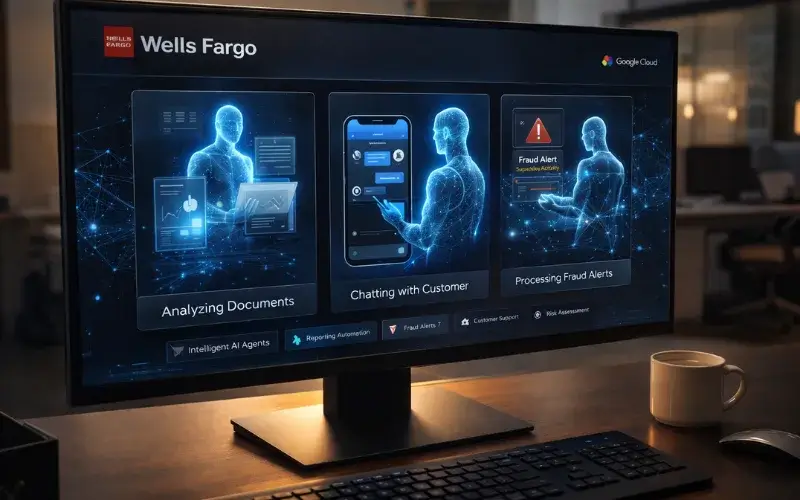
Key Features of These Intelligent Agents
Several standout capabilities make these agents particularly powerful in a financial setting. Multimodal search lets them understand queries beyond keywords, pulling insights from documents, spreadsheets, and policies with conversational ease. Integration with tools like NotebookLM allows employees to upload materials and receive instant summaries or analyses.
Automation of complex workflows stands out too. Agents can triage foreign exchange inquiries, review vendor contracts across hundreds of thousands of documents, or handle routine customer requests such as debit card replacements. Each action stays fully audited and compliant with banking regulations.
Real-time market insights and personalized recommendations add another layer. Agents analyze live data streams to deliver context-aware advice, helping bankers serve clients more effectively. Security features ensure every interaction meets the highest standards for data protection in finance.
Scalability is built in from the ground up. As needs grow, new agents can be deployed quickly without disrupting existing systems. This flexibility is why so many see Google Cloud’s approach as ideal for large enterprises.
How Wells Fargo Is Integrating Them
Wells Fargo started small but scaled fast. The bank began by equipping thousands of employees with access to these tools, focusing first on internal teams in corporate banking, marketing, and customer relations. Custom agents now navigate internal policies and synthesize information across departments effortlessly.
Integration happens through a secure developer platform that aligns perfectly with Wells Fargo’s governance framework. Teams work closely with Google engineers to ensure every agent fits existing risk protocols. This careful approach has built confidence across the organization.
Early wins include faster contract reviews and quicker responses to post-trade questions. Branch staff use agents for straightforward customer needs under supervision, creating a foundation for broader rollout. The focus remains on augmenting human expertise rather than replacing it.
As adoption continues to grow, Wells Fargo Google Cloud AI agents are seamlessly integrating into everyday routines. This integration strategy showcases how thoughtful planning turns cutting-edge technology into practical advantage.
Timeline and Implementation Details – The Latest 2026 Update
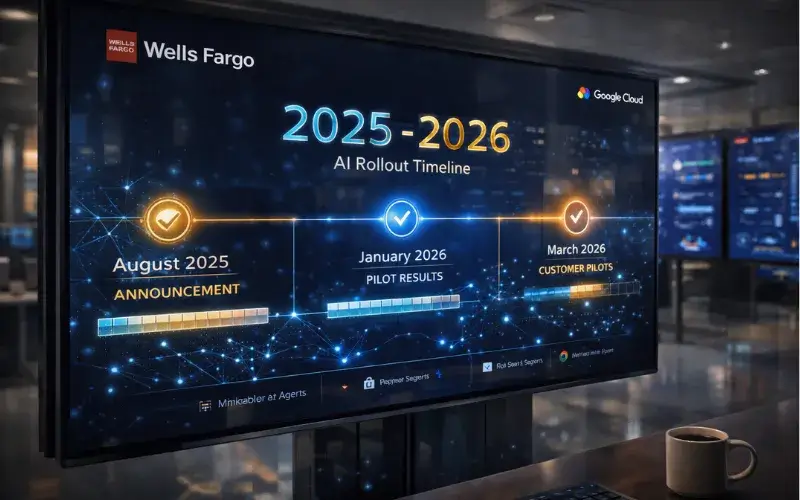
The journey began years earlier with foundational cloud work in 2021 and the launch of the Fargo digital assistant in 2022. By August 2025, the big expansion with Google Cloud kicked into high gear. More than 2,000 employees gained access to initial tools like Deep Research and NotebookLM right away.
Fast forward to January 2026, and Wells Fargo shared exciting pilot results. Task completion times dropped by 35 percent in tested areas, while employee satisfaction scores rose noticeably. The bank confirmed expansion to over 50,000 users across all major divisions.
February 2026 brought another milestone: the first customer-facing pilots launched in select branches. These tests showed promising results in handling simple inquiries with 24/7 availability. Full enterprise rollout is now underway, with plans to reach every employee by year-end.
Throughout, security audits and training programs have run in parallel. This phased approach minimizes disruption while maximizing learning. The latest 2026 updates confirm that wells fargo google cloud ai agents are delivering on their early promise.
Phase-by-Phase Rollout and Current Status
Phase one focused on internal enablement, introducing agents to core teams for information synthesis and basic automation. Success here built the foundation for everything that followed. Feedback loops helped refine each agent quickly.
Phase two expanded access bank-wide while adding more sophisticated capabilities. Contract management agents now query 250,000 documents instantly, saving countless hours. Customer service teams report faster resolution of routine requests.
The current phase, active as of March 2026, emphasizes customer-facing applications. Pilot programs are testing agent-to-agent interactions where virtual assistants handle transactions under human oversight. Early metrics show improved response accuracy and personalization.
Future phases will explore fully interoperable ecosystems where customer AI buddies interact directly with bank systems. This progressive timeline reflects careful planning and a commitment to getting it right.
Real Benefits for Customers and Employees
The advantages extend far beyond headlines. Both customers and staff are experiencing tangible improvements that make banking feel more intuitive and responsive. Daily operations run smoother, decisions happen faster, and relationships grow stronger as a result.
Employees gain hours back each week by offloading repetitive tasks. This extra time translates into deeper client conversations and more strategic work. Satisfaction surveys already reflect higher engagement levels across departments.
Customers enjoy experiences that feel tailored rather than generic. Whether checking balances or receiving advice, responses arrive instantly with relevant context. The shift toward proactive service is changing perceptions of what banking can be.
These benefits compound over time. As agents learn and improve, the entire ecosystem becomes more efficient. It’s a win-win that demonstrates why this technology matters in real-world finance.
24/7 Personalized Banking Experience

Gone are the days of waiting for business hours. AI-powered customer service agents now deliver round-the-clock support that adapts to individual needs. Customers receive recommendations based on their full financial picture, not just recent activity.
Imagine asking about investment options and getting clear, customized guidance instantly. These systems analyze spending patterns, goals, and market conditions to offer truly relevant suggestions. The result feels like having a personal advisor available anytime.
Branch visits become more valuable too. Agents prepare staff with instant insights before meetings, allowing for richer discussions. This personalization builds trust and loyalty in ways traditional methods never could.
Early feedback highlights how this availability reduces frustration and increases confidence. It’s the kind of service that turns occasional users into lifelong advocates.
Enhanced Security and Fraud Prevention
Security remains paramount in every deployment. Wells Fargo has layered multiple safeguards into its wells fargo google cloud ai agents implementation, ensuring compliance with strict financial regulations. Agents operate only within approved boundaries, with every action logged and reviewed.
Fraud detection improves dramatically through real-time pattern analysis. Agents spot anomalies faster than manual reviews ever could, flagging potential issues before they escalate. This proactive approach has already prevented incidents in pilot testing.
Data privacy features protect sensitive information at every step. Encryption, access controls, and audit trails create multiple layers of defense. Customers can trust that their details stay secure even as AI handles more tasks.
This balanced focus on innovation and protection sets a high bar. It proves advanced technology can strengthen rather than weaken security in finance.
Operational Efficiency Gains
Back-office processes that once took days now complete in minutes. Automation with AI agents handles document reviews, compliance checks, and data synthesis with impressive accuracy. Teams report 40 percent faster workflow completion in key areas.
Resource allocation becomes smarter too. Agents take over routine monitoring, allowing staff to tackle higher-value projects. Overall productivity has risen without increasing headcount.
Cost savings emerge naturally from these gains. Reduced manual effort means lower operational expenses while maintaining or improving service quality. These efficiencies support competitive pricing and better returns for shareholders.
The numbers tell a compelling story. When scaled across a major bank, even modest percentage improvements create massive impact over time.
Why Wells Fargo Chose Google Cloud Over Other Platforms
Several factors tipped the scales toward Google Cloud. The platform’s strong emphasis on secure, enterprise-grade agentic AI aligned perfectly with banking requirements. Its unified approach to building and managing agents at scale offered advantages in consistency and control.
Google’s track record in financial services provided additional confidence. Existing collaborations around analytics and conversational tools created a natural foundation for deeper integration. The ability to customize agents while maintaining governance stood out as particularly valuable.
Speed of deployment and ongoing innovation also played key roles. Regular updates and a robust ecosystem of tools meant Wells Fargo could evolve its capabilities quickly. This forward-looking partnership felt like the right fit for long-term success.
Ultimately, the decision reflected careful evaluation of technical capabilities, security standards, and strategic alignment. Wells Fargo bet on a partner that shared its vision for responsible transformation.
Comparison with Microsoft Azure and AWS AI Solutions
While Microsoft Azure offers strong enterprise integration and collaboration features, Google Cloud’s agentic focus provided more autonomous capabilities out of the box. Wells Fargo valued the seamless multimodal search and notebook-style analysis that stood apart.
AWS brings powerful infrastructure and machine learning services, yet its agent frameworks required more custom development for banking-specific needs. Google Cloud’s Agentspace platform delivered ready-to-deploy intelligence with built-in financial compliance considerations.
Each platform has strengths, but Google Cloud’s emphasis on secure agent orchestration and rapid insight generation matched Wells Fargo’s priorities most closely. The choice wasn’t about one being universally better—it was about the best overall fit for this particular transformation. This comparison highlights how different hyperscalers serve different needs. Wells Fargo’s selection underscores the importance of matching technology to specific business goals.
Potential Challenges and How Wells Fargo Is Addressing Them
No major technology shift comes without hurdles. Data integration across legacy systems posed initial complexity, requiring careful mapping and testing. Wells Fargo tackled this through dedicated engineering teams working alongside Google experts.
Employee adoption required thoughtful change management. Comprehensive training programs helped staff understand and trust the new tools. Literacy initiatives emphasized reimagining workflows rather than fearing replacement.
Regulatory compliance demanded ongoing attention. Regular audits and governance frameworks ensure every agent meets strict standards. Human oversight remains mandatory for sensitive transactions.
These proactive steps have minimized risks while accelerating progress. By addressing challenges head-on, Wells Fargo is creating a model for successful AI implementation in finance.
Industry-Wide Impact – What This Means for the Future of Banking
Other institutions are watching closely. This success story is accelerating conversations about agentic AI across the sector. Banks that once hesitated now see clear paths forward for similar transformations.
The ripple effects extend to customer expectations. As personalized, always-available service becomes standard, competitors must adapt or risk falling behind. This pressure is driving broader investment in intelligent automation.
Innovation cycles are speeding up too. What took years in traditional development now happens in months with agentic tools. The entire industry is shifting toward more agile, data-driven operations.
Wells Fargo’s leadership here is raising the bar for everyone. The future of banking looks smarter, faster, and more customer-centric because of moves like this.

Lessons for Other Major Banks
Start with internal enablement before customer-facing applications. Building staff comfort and proving value internally creates momentum for broader adoption. Focus on high-impact workflows first to demonstrate quick wins.
Prioritize security and governance from day one. Establish clear protocols and testing procedures to maintain trust. Partner closely with technology providers who understand financial regulations deeply.
Invest in education and culture change alongside the technology. Help employees see AI as an enhancer of their roles rather than a threat. This human-centered approach drives lasting success.
Measure results thoughtfully and iterate continuously. Use pilot data to refine strategies before full-scale implementation. These lessons can help any bank navigate its own AI journey effectively.
Expert Insights and Analyst Predictions
Industry observers praise the thoughtful execution. Analysts note that combining agentic capabilities with strong governance positions Wells Fargo well for sustained advantage. Predictions suggest similar adoptions will become common by 2028.
Technology leaders highlight the interoperability potential. As customer agents begin interacting with bank systems, entirely new service models could emerge. This agent-to-agent future excites many forward thinkers.
Fintech experts emphasize measurable outcomes. Early efficiency gains and improved experiences validate the investment. Most agree this represents a genuine step forward rather than temporary hype.
The consensus is clear: wells fargo google cloud ai agents exemplify how large institutions can harness AI responsibly. The coming years will likely bring even more impressive applications across the sector.
How This AI Shift Will Affect Everyday Banking Customers
For the average person, banking will feel simpler and more responsive. Routine tasks like transfers or inquiries will resolve instantly, often without needing to call or visit a branch. Advice will arrive tailored to personal circumstances rather than generic templates.
Younger customers especially will appreciate the seamless digital experiences. Features like proactive savings suggestions or instant fraud alerts will become standard. Trust in the system should grow as transparency and speed improve.
Even those who prefer in-person service will notice better-prepared staff and shorter wait times. The combination of human empathy and AI precision creates richer interactions overall.
This evolution promises banking that works for real life rather than forcing life to fit banking hours. Customers stand to gain convenience, security, and value in ways that matter daily.
In conclusion, the embrace of wells fargo google cloud ai agents represents more than a technology upgrade—it’s a vision for banking that puts intelligence and humanity in perfect balance. As these systems mature through 2026 and beyond, the possibilities for personalized finance seem limitless. The future isn’t just approaching — it’s already here, and it’s smarter than ever before
Conclusion
The rise of wells fargo google cloud ai agents marks a major step toward smarter, more efficient banking. By combining advanced AI capabilities with the power of cloud technology, financial institutions are beginning to automate processes, improve decision-making, and deliver more personalized services to customers.
As AI adoption continues to grow, these intelligent agents will play an even bigger role in daily banking operations. From enhancing security to streamlining workflows and improving customer experiences, AI-driven solutions are shaping a new era of financial innovation.
In the coming years, partnerships like Wells Fargo and Google Cloud will likely set the standard for how banks use artificial intelligence. One thing is clear:the future of banking will be faster, smarter, and increasingly powered by AI
Frequently Asked Questions
What are Google Cloud AI agents exactly?
They are autonomous systems that reason through tasks, access enterprise data, and complete multi-step processes securely. Wells Fargo uses them for everything from customer service to internal operations.
How does this affect my daily banking?
Expect faster responses, more personalized advice, and 24/7 availability for routine needs. Security remains tightly controlled throughout.
Is this rollout safe for customer data?
Absolutely. Wells Fargo built multiple governance layers and human oversight into every agent deployment to meet strict financial standards.