
If you’re running a U.S.-based business right now, you’ve probably felt it: traffic is getting more expensive, attribution is murkier, and paid media performance isn’t as predictable as it was even three years ago. That’s exactly why Conversion Rate Optimization in 2026 is no longer a “nice to have” — it’s a board-level growth lever.
Across SaaS, eCommerce, and B2B services in the United States, customer acquisition costs have steadily climbed. In competitive sectors like legal, insurance, home services, and B2B software, Google Ads CPCs routinely cross $15–$40 per click. In some niches, they go much higher. When traffic costs that much, squeezing another 20–40% lift from your existing visitors has a bigger impact than doubling your ad budget.
At the same time, privacy changes, first-party data restrictions, and platform-level algorithm shifts have reduced the reliability of traditional targeting. Third-party cookies are fading. iOS tracking limitations changed how we measure conversions. Attribution windows are shorter. In this environment, optimizing the experience after the click is the safest, most controllable growth strategy.
That’s the context behind Conversion Rate Optimization in 2026. It’s no longer about button colors and basic A/B testing. It’s about AI-powered behavioral analytics, predictive modeling, dynamic personalization, and data-driven funnel architecture built specifically for U.S. consumer behavior.
Let’s break down what’s changed, what’s working, and how to build a conversion system that holds up in today’s market.
Why U.S. Businesses are Focusing on CRO More Than Traffic
In today’s competitive US market, the mantra of ‘More Traffic’ is outdated. There are several compelling reasons for this that reflect the business reality of 2026:
Rising Ad Costs: The average CPC (Cost Per Click) in the U.S. has now reached $20-$50 in many competitive industries, such as legal, finance, and SaaS. Running ads without conversion rate optimization is like throwing money into the fire.
Privacy & Regulation (CCPA/GDPR): With the end of third-party cookies, precise targeting has become difficult. You now have to rely on your first-party data, and Conversion Rate Optimization in 2026 helps you make the most of that data.
Customer Expectations: Today’s American consumer is highly value-conscious. If your website’s User Experience (UX) is slow or confusing, they will immediately switch to your competitor.
What Has Changed in Conversion Rate Optimization in 2026?
Over the past few years, the definition and techniques of CRO have undergone a revolutionary shift. We have moved from a ‘static’ era to a ‘dynamic’ era.
Evolution of CRO: From 2022 to 2026
Around 2022, CRO was primarily limited to changing button colors, headlines, and manually viewing heatmaps. But Conversion Rate Optimization in 2026 is completely driven by AI and Machine Learning. Today, we don’t just look at where a user clicked, but AI tells us why a user is going to click (Predictive Modeling).
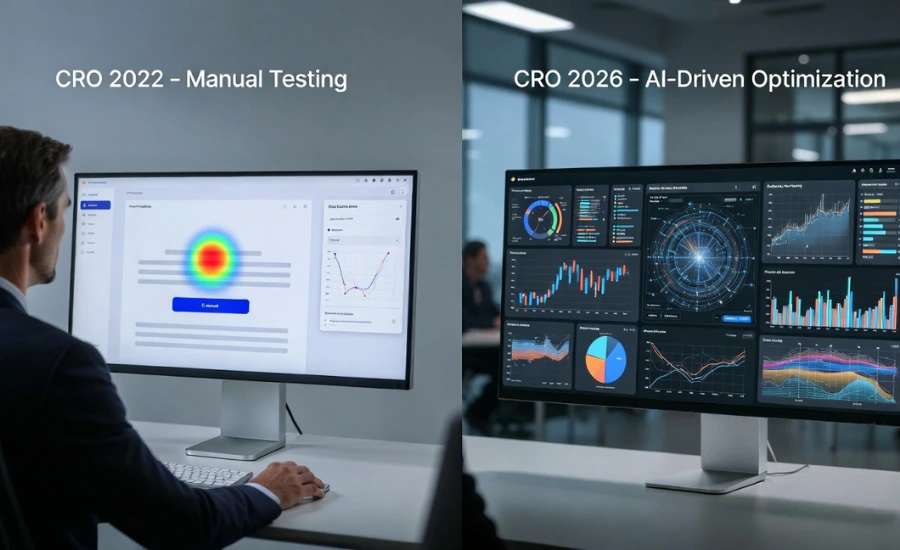
| 2022 CRO | 2026 CRO |
| Basic A/B testing (Manual) | AI Predictive Testing & Auto-evolution |
| Manual Heatmaps & Session Replays | Behavioral Automation & Intent Scoring |
| Static Funnels (Same for everyone) | Dynamic Personalization (Unique for each user) |
| Reliance on Third-party Cookies | First-party Data & Privacy-centric Tracking |
| Desktop-first approach | Mobile-first & Voice-search Optimization |
From Basic A/B Testing to AI-Driven Personalization
We no longer wait months for an A/B test to run. AI engines can now test thousands of variations in real-time and automatically show the version that will work best for that specific user.
Predictive Behavior Modeling
user’s exit intent based on their mouse movements and scrolling patterns, and immediately trigger a personalized offer that matches their previous browsing history.
Key U.S. Market Trends Driving Conversion Rate Optimization in 2026
The U.S. marketplace has consistently led the way in driving innovation. In 2026, marketing managers and business owners must stay informed about the following major trends shaping the industry.
AI-Powered Behavioral Analytics
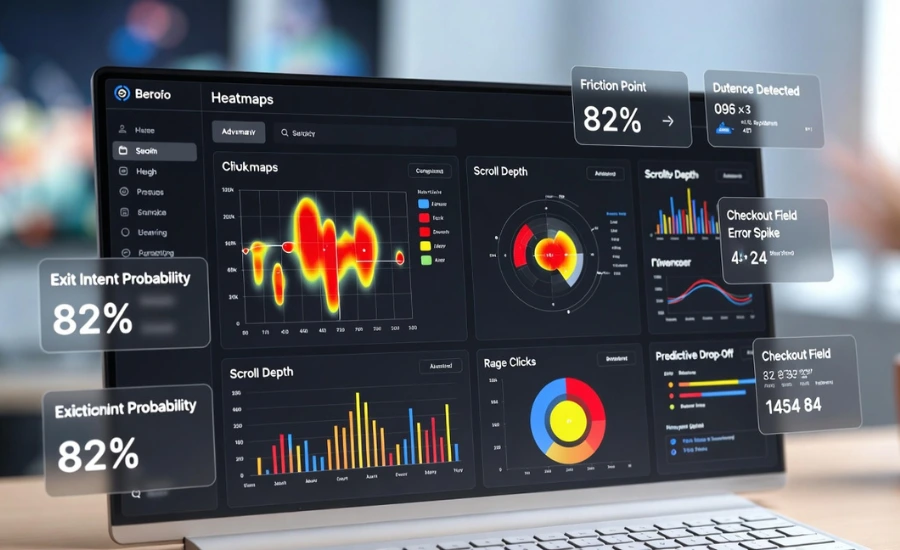
Old tools only provided data, but the AI CRO tools of 2026 provide insights. They automatically identify friction points where users are dropping off. For example, if people are getting stuck on the ZIP code field in your checkout form, AI will alert you immediately.
First-Party Data Importance
With privacy laws tightening, zero-party and first-party data has become a treasure trove. Successful U.S. brands are now using quizzes, surveys, and interactive tools to learn directly from customers about their preferences and optimize conversions based on that.
Privacy & Cookieless Tracking
Concern about data privacy has increased among consumers in the U.S. A large part of Conversion Rate Optimization in 2026 has shifted to “server-side tracking,” which ensures data accuracy and respects user privacy.
Hyper-Personalized Landing Pages
The days of one-size-fits-all marketing are over. If someone searches for “best CRM for small law firms” and lands on your website, they should see a page tailored for legal professionals—highlighting their specific challenges and case studies—not a broad, generic SaaS pitch.
CRO for Mobile-First U.S. Shoppers
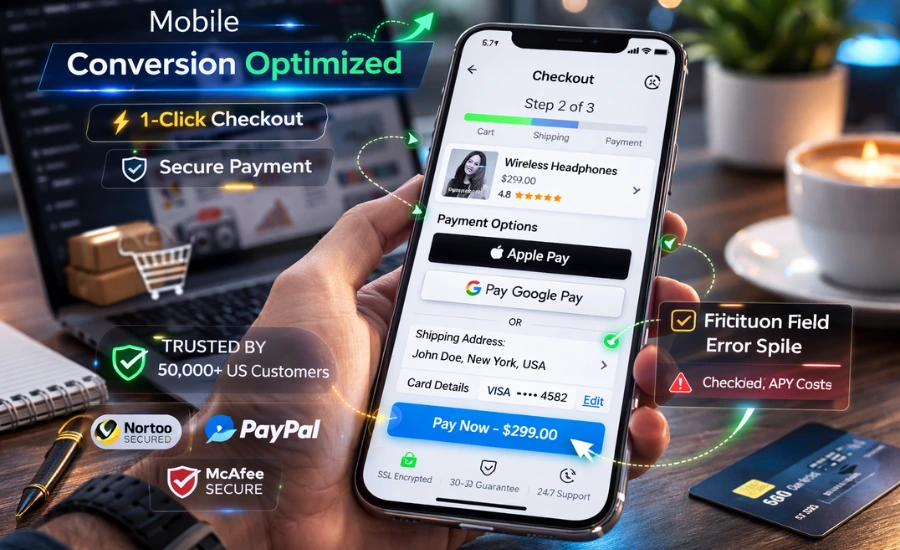
More than 80% of e-commerce transactions in the US now originate on mobile. In 2026, mobile CRO means more than just responsive design, but seamless integration of Apple Pay/Google Pay and thumb-friendly navigation.
AI Tools Transforming Conversion Rate Optimization in 2026
A strategy is only successful if it has the right tools. The choice of tools in 2026 directly impacts your ROI.
AI Tool Comparison for 2026
| Tool Type | Use Case | Best For | Impact Level |
| AI Heatmaps | Real-time visual tracking | SaaS & eCommerce | High |
| AI Session Replay | Understanding user friction | Complex Checkouts | Very High |
| Predictive Popups | Reducing Bounce Rate | Retail & Lead Gen | Medium |
| Smart Personalization | Dynamic Content | Enterprise Brands | Critical |
| CRO Automation | Auto-scaling winners | High-traffic sites | High |
AI Heatmaps and Behavioral Tools
Old heatmaps took weeks to compile. In 2026, AI-powered heatmaps can predict where the next 10,000 people will click with 95% accuracy based on the first 100 visitors.
Smart Personalization Engines
These engines change the layout of an entire website based on a user’s geographic location, local weather (e.g., showing a heavy jacket during a snowfall in New York), and previous purchases. This is the ultimate level of landing page optimization.
Step-by-Step CRO Framework for U.S. Businesses in 2026
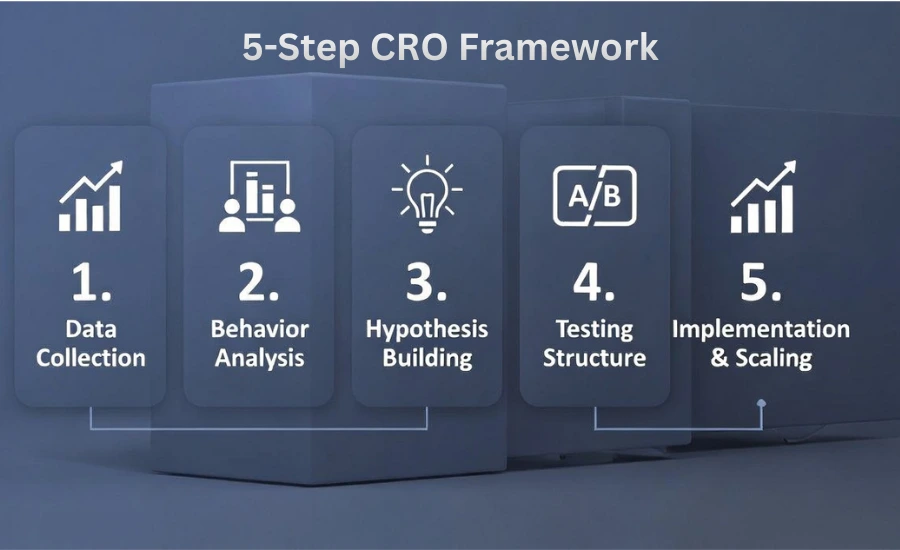
If you want to organically increase your conversions, you need a process. Here’s my tried-and-true 5-step framework:
Data Collection
Without data, you’re just shooting in the dark.
- Set up Google Analytics 5 (GA5) and server-side tracking.
- Track micro-conversions (e.g., newsletter signups, video watches).
Checklist: Verify cross-domain tracking
- Set up custom event tracking for all buttons
- Ensure data privacy compliance (CCPA)
Behavior Analysis
Here we move from “what” to “why.”
- Watch AI-driven session replays to identify ‘Rage Clicks.’
- Use Form Analytics to see which fields people are leaving blank.
Checklist:
- Review top 20 exit pages
- Identify device-specific drop-offs
- Conduct 5-second usability tests
Hypothesis Building
Make a logical assumption based on the data. “If I make [change], [metric] will increase because [reason].”
Checklist:
- Rank hypotheses by ICE score (Impact, Confidence, Ease)
- Align hypothesis with business goals
- Ensure clear success metrics are defined
Testing Structure
Start A/B testing or multivariate testing. In 2026, use the ‘Exploitation vs. Exploration’ algorithm to avoid revenue loss even during testing.
Checklist:
- Set minimum sample size (using Bayesian statistics)
- Run tests for at least one full business cycle
- Avoid ‘Peaking’ at results too early
Implementation & Scaling
When a test is successful, immediately deploy it across the entire platform and then try to improve it further based on new data.
Checklist:
- Document all learnings (even failed tests)
- Automate the winning variant deployment
- Plan the next iterative test
Conversion Rate Optimization in 2026 for Different Industries
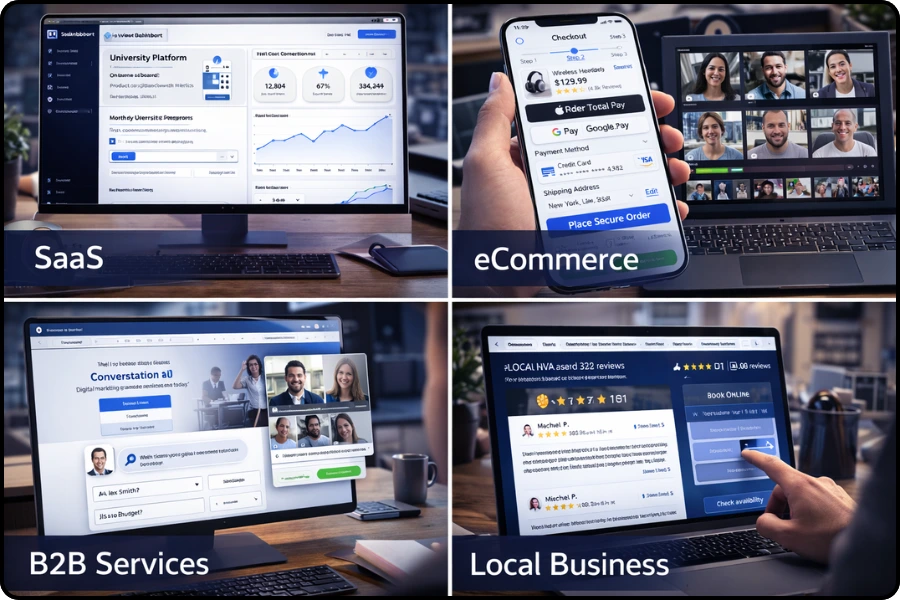
Every industry has its own challenges. The strategy of an e-commerce store in 2026 will be completely different from that of a B2B SaaS company.
SaaS (Software as a Service)
“Product-Led Growth” (PLG) is expected to dominate the U.S. SaaS market in 2026. Here, CRO means reducing not just ‘sign-up’, but ‘time to value’.
- Micro-optimization: Reduce friction in the onboarding process.
- Pricing Page: Display dynamic pricing that varies according to the size of the user’s company.
eCommerce
E-commerce is all about ‘trust’ and ‘speed’.
- Visual Search: Allow users to search for products by taking photos.
- One-Click Checkout: In 2026, if you don’t have a seamless checkout like Amazon, you’ll be left behind.
- Social Proof: Use AI-curated video reviews.
B2B Services
When it comes to B2B, strong, qualified leads outperform large quantities of unqualified ones.
- Conversational AI: Use AI chatbots that can qualify leads (MQL/SQL) instead of boring forms.
- High-intent Content: Optimize whitepapers and case studies that attract decision-makers.
Local Businesses in the USA
Whether you’re a dental clinic in New York or a plumbing service in Texas, ‘Local Trust Signals’ matter most in local CRO.
- Google Business Profile Optimization: Link maps and reviews directly to your site.
- Speedy Booking: The ability to book appointments directly from your website is a must-have in 2026.
Conversion Rate Optimization Audit Checklist (2026 Edition)
Before optimizing your site, it’s important to understand where it stands today. Use this table for a quick CRO audit.
| Area | What to Check | Why It Matters | Priority |
| Site Speed | LCP < 1.2s on mobile | Search ranking & bounce rate | Critical |
| Mobile UX | Thumbs-only navigation | 80%+ U.S. mobile traffic | High |
| Copywriting | Benefit-driven headlines | Aligns with user intent | High |
| Trust Signals | Social proof, SSL, BBB labels | Crucial for U.S. shoppers | Medium |
| Forms | Auto-fill & minimal fields | Reduces abandonment | Critical |
| Accessibility | ADA Compliance | Legal requirement in U.S. | High |
| AI Integration | Chatbots & Personalization | 2026 competitive edge | Medium |
Common CRO Mistakes U.S. Businesses Are Making in 2026
Over the years of experience, I’ve seen even major brands make mistakes that cost them millions of dollars.
- Over-optimizing Traffic: People spend money on ads but don’t realize the landing page’s message doesn’t match the ad. This is called ‘Message Match,’ and it’s the foundation of a conversion funnel strategy.
- Ignoring Micro-conversions: Focusing solely on ‘Sale’ is a mistake. If a user downloads your guide or adds items to their cart, these are small signals that need to be tracked.
- No Personalization: In 2026, if you’re showing winter coats to a user in Florida, you’re losing credibility.
- Testing Without Data Depth: Don’t test based on gut feelings. Don’t draw conclusions unless you have statistical significance.
- Copy Not Aligned with Intent: Copywriters often write fancy words, but the user just wants a solution to their problem. Simple and clear copy always wins.
How to Measure Success in Conversion Rate Optimization in 2026
Just looking at ‘Conversion Rate’ isn’t enough. You need to dig deeper.
- Revenue Per Visitor (RPV): This is the most important KPI. If your conversion rate is stable but RPV is increasing, you’re on the right track.
- Customer Acquisition Cost (CAC) Ratio: Are your CRO efforts reducing your ad spend?
- Lifetime Value (LTV): Good CRO means bringing customers back again and again, not just a one-time sale.
- Funnel Drop-offs: Track losses at each stage.
Example Metric Table
| Metric | Target (Good) | Action if Low |
| Landing Page Conversion | 5% – 10% | Simplify copy/offer |
| Cart Abandonment Rate | < 60% | Check for hidden costs |
| Repeat Purchase Rate | > 20% | Improve post-purchase flow |
| Average Order Value | $100+ (Industry dependent) | Upsell/Cross-sell AI triggers |
Future of Conversion Rate Optimization Beyond 2026
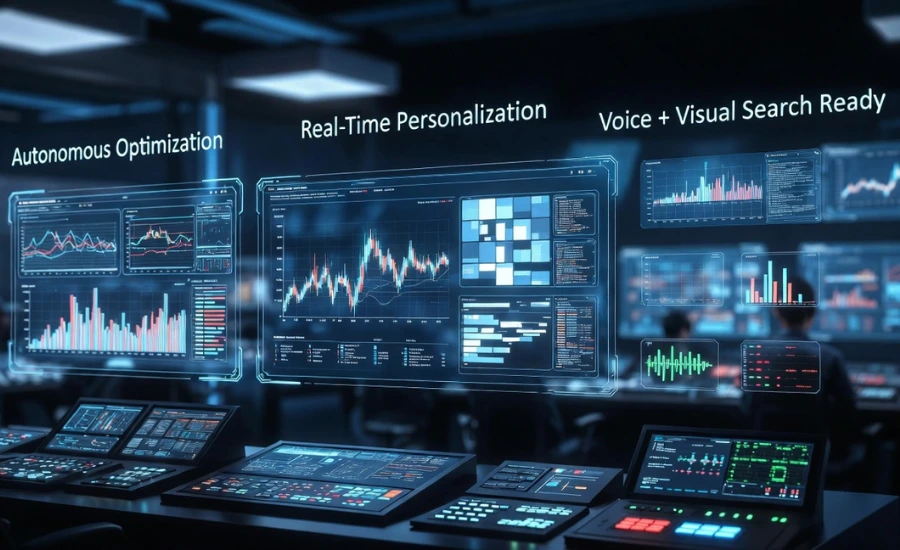
What we see today in 2026 is just the beginning. CRO in the future is going to be even more ‘invisible’ and ‘intuitive.’
AI Autonomous Optimization
In the future, you won’t need to manually create tests. AI will automatically find flaws in your site, create a new design, test it, and implement it if successful. Humans will only be able to provide strategy and creative direction.
Real-time Personalization through Bio-signals
Although it sounds a bit futuristic right now, sites will be able to change their color and tone based on a user’s ‘mood’ by using data from wearables and eye-tracking technology.
Voice + Visual Search Conversion
As smart speakers and AR glasses (Apple Vision Pro, etc.) gain popularity, optimizing ‘Voice UI’ will become an essential part of Conversion Rate Optimization in 2026.
Final Thoughts on Conversion Rate Optimization in 2026
The US market in 2026 is not for those stuck in old ways. Today, data and AI are your best friends. If you want to scale your business, you must put Conversion Rate Optimization in 2026 at the center of your marketing strategy.
Remember, CRO is not a ‘one-time project,’ but a ‘continuous improvement’ process. Every click tells a story, and as a successful marketer, your job is to understand that story and bring it to a happy ending (conversion).
In the increasingly competitive US market, only those brands that value their customers’ time and attention will win. And the best way to do that is by providing a seamless, personalized, and effective digital experience.
Frequently Asked Questions About Conversion Rate Optimization in 2026
1. What is considered a good conversion rate in 2026?
This depends entirely on your industry. However, 3-5% for U.S. eCommerce and 7-12% for SaaS (free-to-paid) are considered good. What’s important is whether you’re improving on your past performance.
2. Will AI completely replace human CRO specialists?
No. AI is excellent at processing data and finding patterns, but human brains will always be needed for ‘Brand Voice,’ ‘Empathy,’ and ‘Creative Strategy.’ AI is a powerful tool, not a replacement.
3. Is CRO even necessary for small companies?
In fact, it’s even more important for small companies. They have limited budgets, so they need to maximize every dollar and every visitor.
4. What is the most important CRO tool in 2026?
No single tool is best, but the combination of a good behavioral analytics platform (like Hotjar’s AI version or VWO) and a strong personalization engine is most effective.
5. How long does it take to see CRO results?
This depends on your traffic volume. High-traffic sites may see results within a few days, while low-traffic sites may take 4-8 weeks to reach statistical significance.